May 20, 2015

Blessed Martin Martinez Pascual

Blessed Martin Martinez PascualMartin was born on the 11th November 1910 in Valdealgorfa in Aragon, Spain. He discerned a vocation to the priesthood at an early age and entered the seminary in Belchite. In 1934 he joined the Diocesan Worker Priests of the Sacred Heart, and was ordained on the 15th June 1935. He was appointed Prefect of St Joseph's College, Murcia and professor at the seminary in San Fulgencio.

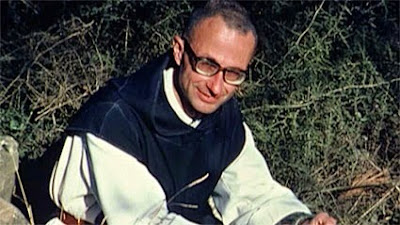
The following summer, he went to his home for his vacation when the persecution of Catholics began in July 1936. He hid out in a friend's house, and later moved to a cave for safety. In August he heard that his father had been arrested, so he left his place of refuge to try to save him. On the 18th August Martin went before the committee that was examining Senor Martinez and there they discovered that the son was a priest. He was immediately arrested, and that same day brought out and shot with other priests who had also been captured. Just before he was executed, a moment after those photographs were taken, he was asked if he wanted to turn away so he would not see the guns. He refused, saying he wanted to ask God's forgiveness for those who were killing him and to give them his blessing. His only crime was to be a priest of the Most High. So they asked him if he wanted to say something. Martin replied: “I only give you my blessing that God does not take into account the madness that you commit.” And then he cried: “Viva Cristo Rey” (Long live Christ the King)

A few moments before this young priest was martyred for his Catholic faith this photograph was taken. The photographer was Hans Gutmann, a supporter of the Republican cause and he wanted to capture the priest's last moments. Fr Martin was fully aware that he was about to die, and yet he stood calmly beside one who was about to shoot him and smile for the camera. Blessed Martin was beatified on the 1st October 1995. His feast day is the 18th August.

The Trappist Martyrs of Tibhirine, Algeria, 1996

The Trappist Martyrs of Tibhirine, Algeria, 1996
On the night of March 26-27, 1996, seven monks from the monastery Notre-Dame de l'Atlas of Tibhirine in Algeria, belonging to the Order of Cistercians of the Strict Observance (O.C.S.O.), or Trappists, were kidnapped and later killed during the Algerian Civil War.

At about 1:15 AM on March 27, 1996, some twenty armed men arrived at the monastery of Tibhirine and took seven monks into custody. Two others, Fr. Jean-Pierre and Fr. Amédée, who died in 2008, escaped the kidnappers' notice, hidden in separate rooms. After the kidnappers left, the remaining monks tried to contact the police, but the telephone lines had been cut. Because of the curfew in force, they could only wait until morning before driving to the police station in Médéa.

On April 18, the Armed Islamic Group (GIA - Groupe Islamique Armé) issued communique #43, demanding the release of GIA leader, Abdelhak Layada, as the price for the monks' lives. On April 30, a tape with the voices of the kidnapped monks, recorded ten days earlier, was delivered to the French Embassy. On May 23, the Armed Islamic Group's communique #44 reported that the Armed Islamic Group had killed the monks on May 21. The Algerian government announced that the monks' heads had been discovered on May 31; their bodies were never found. A funeral Mass was celebrated in the Catholic Cathedral of Notre Dame d'Afrique (Our Lady of Africa), Algiers, on June 2, 1996, and their remains were buried in the cemetery of the monastery at Tibhirine on June 4. The surviving two monks of Tibhirine left Algeria, to live in the Trappist annex near Midelt in Morocco, where the late Father Bruno had been superior.

The Trappist Martyrs of Tibhirine, Algeria, 1996

The circumstances of the Tibhirine monks' kidnapping and deaths remain controversial. In 2008, the Italian newspaper La Stampa reported that an anonymous high-ranking Western government official, then based in Algeria and in Finland, had told them that the kidnapping had been orchestrated by a GIA group which the DRS (Département du Renseignement et de la Sécurité, the Algerian state intelligence service) had infiltrated , and that the monks had then been killed accidentally by an Algerian military helicopter attacking the camp where they were being held captive. In 2009, the retired French general, François Buchwalter, who was military attaché in Algeria at the time, testified to a judge that the monks had accidentally been killed by a helicopter from the Algerian government during an attack on a guerrilla position, then beheaded after their death to make it appear as though the GIA had killed them. Ex-GIA leader Abdelhak Layada, who was in prison when the monks were killed, but was later freed under a national amnesty, responded by claiming that the Armed Islamic Group had indeed beheaded them after negotiations with the French secret services broke down.

Brother Christian, prior of the Tibhirine monastery, left behind a letter which he had written on New Year's Eve, 1993, to be opened by his community and family in the event of his death. He and the other monks were well aware of the growing tensions in Algeria, and that he, and they, might well become "a victim of terrorism which now seems ready to engulf all the foreigners living in Algeria". In the letter he assures those left behind that, while he doesn't desire such a death, indeed doesn't feel worthy of such an offering, he could never rejoice:
The Trappist Martyrs of Tibhirine, Algeria, 1996
Brother Christian de Chrege
"if the people I love were to be accused indiscriminately of my murder. To owe it to an Algerian, whoever he may be, would be too high a price to pay for what will, perhaps, be called, the 'grace of martyrdom', especially if he says he is acting in fidelity to what he believes to be Islam. I am aware of the scorn which can be heaped on Algerians indiscriminately. I am also aware of the caricatures of Islam which a certain Islamism encourages. It is too easy to salve one's conscience by identifying this religious way with the fundamentalist ideologies of its extremists. For me, Algeria and Islam are something different: they are a body and a soul. I have proclaimed this often enough, I believe, in the sure knowledge of what I received from it, finding there so often that true strand of the Gospel, learnt at my mother's knees, my very first Church, in Algeria itself, and already inspired with respect for Muslim believers..."

May 19, 2015

Bl. Peter To Rot: Martyr of Marriage

Bl. Peter To Rot: Martyr of Marriage
Peter To Rot was born in 1912 in a village named Rakunai in what is today Papua New Guinea. The region had for some time been visited by Christian missionaries, but Peter’s father, Angelo To Puia, who was chief of the village, and his mother, Maria la Tumul, were baptized as adults and were among the first Catholics in the country.

Peter was one of six children and from an early age he was very interested in his faith. Because of this, he was trained to be a catechist, a teacher of religion. So when Peter was 18 he became a student at St. Paul’s Mission School. He was a very good student and became a catechist within three years, the youngest of all the catechists in Papua New Guinea. He worked with the people of Rakunai and was known to be an excellent teacher. Peter always carried a Bible with him and knew much of it by heart. In 1936 he married Paula la Varpit, a Catholic from a nearby village. They had three children, but only his daughter, Rufina, survived past childhood.

World War II changed the lives of the people of Papua New Guinea forever. The Japanese forces occupied the island nation, and all missionaries were imprisoned. This left Peter as the only spiritual leader of all Catholics in the area. He provided prayer services, instruction, the Eucharist and Baptism for people and helped the poor. He built a church for Catholics from tree branches — the only material available. When people were afraid, he reminded them that God was with them.

In 1942, the Japanese forbade all Christian worship and any type of religious gatherings, even those in homes. They wanted the local chieftains to cooperate with them and tried to push the tribes back to their pre-Christian forms of life, including such practices as having several wives. Peter’s older brother supported this. But Peter did not, and when he became loud in his protests and was known to hold Catholic prayer services in caves, he was seen as a problem for the Japanese. In 1945 he was arrested and sentenced to several months in prison.

But the Japanese leaders had no intention of allowing Peter to leave prison, because his catechetical work and the support people had for him was too dangerous to their cause. At one point he told his visiting wife and mother that a Japanese doctor had been called to give him medicine, even though he had not been sick, and he believed he would be killed. He told his family that he would die for the Church.

He was praying when men came for him. Witnesses say he was given a drink and an injection, and his mouth was covered. The next morning, Japanese authorities acted very surprised to find Peter To Rot dead. But marks on his body and other signs made it clear he had not died of natural causes.

He was given a chief’s funeral in the Catholic cemetery, but the funeral was held in silence because people feared the Japanese. From the day of his funeral, he was seen as a martyr for the Catholic faith.

On January 17, 1995, Pope John Paul II visited Papua New Guinea to celebrate the beatification of Peter To Rot.

Purificacion Pedro

Purificacion Pedro was a church social worker who died in a Bataan hospital in 1977 while under military detention.

Purificacion Pedro, known as Puri to her friends, took up a degree in social work at the University of the Philippines in 1969. She was among the topnotchers in the National Board Examination for Accreditation of Social Workers. For the next four years, she served as a devoted social worker of the Immaculate Conception Parish in Quezon City.

Purificacion (“Puri”) spent most of her professional years working as social worker at Immaculate Concepcion Parish in Cubao, Quezon City. She helped run a parish day nursery, a sewing group for urban poor women and several cooperatives. During the floods in 1972, Puri volunteered her services, bringing medicine and relief goods to many affected areas around Quezon City.

She left her parish job in 1974 and worked as a volunteer for the organizations supporting the anti-Chico Dam movement in Northern Luzon. In 1976, she had been accepted as a staff member of the Luzon Secretariat for Social Action (LUSSA).

But she died before she could start on the job. Days before, Puri had gone on a clandestine trip to Bataan to visit with friends who have joined the New People’s Army. Her timing was off , however, because a military operation was in progress at the area. She was captured in an armed encounter, with a bullet wound in her shoulder.

Puri’s family found her at the Bataan Provincial Hospital, recovering from her wound and under military guard. Her relatives took turns watching her because Puri asked them never to leave her alone with her military captors.

On her sixth day of confinement, however, constabulary intelligence men from Manila came and forced their way into her room. They drove out Puri’s watcher, saying they were interrogating Puri. Puri was left alone with them for one hour inside her hospital room. After they had left, Puri was found dead, strangled inside her hospital bathroom. She was 29 years old.